
Roometric
Role and Scope
Brand & Product Design / Design system architecture · Duration: 2020 - 2026
Scope note: direction, system architecture, and design specs were mine to define. Leonhard Thyssen, Roometric's CEO, acting as Product Owner, handled developer handovers and walked me through the implementations, which rarely needed further QA from my side. I'm normally hands-on directly with engineers, but this was the collaboration model that worked best on this project.
Introduction
Roometric specializes in AR-based measurement software: point a smartphone camera at a room and get an accurate floorplan back within minutes, along with legally certified living-space calculations. The product has been tailored for property management, housing, and construction companies.
How it started
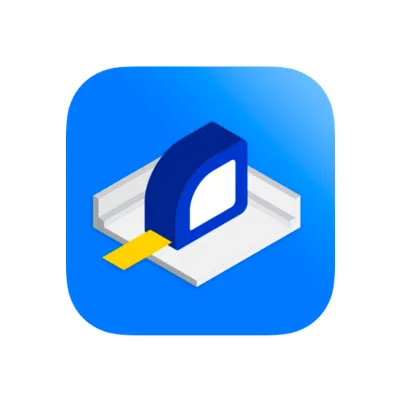

Two logo concepts were developed, and both ended up being used. The old school tape measure was initially selected and ran on the marketing website, but the stylised R replaced it a few months later, for its more timeless look, recognisability, and easier application across the various surfaces it had to work on.
Roometric first brought me on to design their logo. That turned into full product design work not long after, starting with a complete visual skinning of the app.
The problem
The Roometric app carried no distinguished visual identity and was largely built on stock native iOS components. That might have been fine for something simple, which Roometric's product wasn't. Realizing the AR measurement functionality's full potential needed a more sophisticated component set and a much higher level of customization than just re-skinning native components would have allowed.
The approach: a design system, not a redesign
Re-imagining the core features with a custom UI turned into the Roometric design system, built to keep pace with a product that kept growing. This wasn't the first design system I'd built; I brought that prior experience directly into how I structured this one. Rather than designing screen by screen, feature by feature, the goal was a system robust enough to roll out new functionality across the app with out rebuilding foundations each time.
Everything began with a free Figma account, though it was already built with future scalability in mind. Reflecting the sepration of concerns through pages.
The architectural call
The app's complexity meant two things had to be true at once: the system needed to be flexible enough to support Roometric's evolving brand and feature set, and rigid enough that interaction patterns stayed consistent no matter how much the surface changed around them. The system was built with a clear split:
Surface
Structure
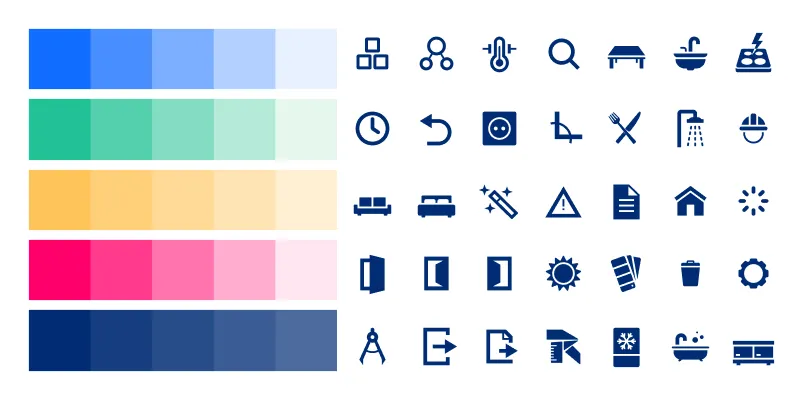
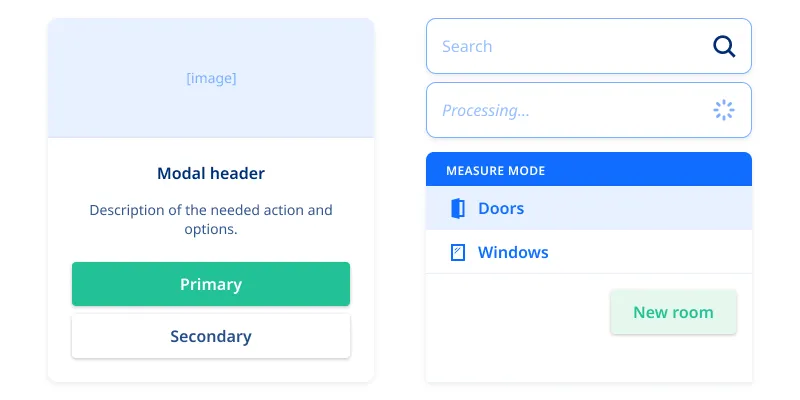
The system held up well enough that Leo could piece together valid specs for smaller features himself, without me. That was the proof that the guardrails were doing their job, and it freed my time to focus on more complex userflows and edge cases that needed further design judgment than simply shuffling new views with a set of already created components.
Scaling the workflow
Early on, everything lived in one Figma file, a fully working prototype of the entire app along with its components. As the system matured, I pitched splitting it: the UI kit and design system would move into their own file, referenced by the app-level file rather than duplicated inside it. Scalability was the case I made, the same argument that had shaped the system's architecture from the start.
The split helped, but it didn't resolve the underlying disagreement. Roometric had gotten used to always having a fully working version of the app in Figma. Once a team is used to that, it's a hard habit to walk back. My view was, and is, that a design tool without production-level fidelity should only hold high-level abstractions — color, type, icon sets, the UI kit — while feature specs stay disposable: accurate for the sprint, discarded once shipped, because production is the real source of truth. We never fully aligned on that, and it made sense why: the system was mature enough that feature delivery speed wasn't a real problem for Leo or the developers, and the cost of keeping one master file alive fell entirely on me. Without pressure on their side, there was no real push to change it. Over optimising for a scale that isn't yet justified can hinder a working process more than an acceptable level of messiness.
What did force periodic resets were "housekeeping" sprints, triggered whenever developers started losing their way in a tangled set of specs. Beyond that, process stayed light: we tried Jira tickets for a while, but with just the two of us on design, most work ran on a simple brief → feedback → follow-up cycle over short calls.
Beyond Roometric: external clients
Roometric's AR measurement technology wasn't only used inside their own app. Parts of it were licensed to external clients, who needed the same measurement functionality running inside their own products, under their own brand.
Work for external clients came in two distinct modes. One was production: specs built to ship, for clients already signed. The other was persuasion: realistic prototypes built to win over prospects Leo was still courting — briefed to dream big on what the AR measurement capability could look like inside a client's product, with Leo sanity-checking the result so it stayed ambitious with out overselling Once a client signed on, delivery followed the same architecture as Roometric's own scaling needs: the structure carried over untouched; only the surface was rethemed. A new client got a design system file based on Roometric's UI kit, rethemed to their brand, and delivered along with their specs. When a client had no existing brand guidelines of their own to work from, I created those alongside the screens, rather than waiting on it to be requested.
These engagements were shorter and narrower in scope than the core Roometric work, and the friction that shaped the core app relationship simply didn't show up here. There was no single sprawling prototype to maintain — the smaller scope never created the same pressure. Handovers were clean: Leo relayed client feedback directly, and specs were iterated against it.
If anything, it was the clearest confirmation that the original architectural call, flexible surface + fixed structure, was the right one. Built to scale within one company, it scaled cleanly beyond it too.
Outcomes
- Six years of ongoing work on the core Roometric app, still active today
- Over 50,000 roomplans created through the app — driving revenue directly, and giving Roometric a working demonstration of AR measurement capability to pitch new external clients
- Another product developed alongside this work eventually grew into its own company → TwinCloud
- Six external clients shipped on the same system, each themed to their own brand with no structural rework required
CLIENT REFERRAL
I worked with Tero for six years, with him as the product designer on our Roometric AR measuring app. What stood out most was the visual clarity of his design: Clean, understandable interfaces that didn't need explaining. His approach was pragmatic rather than dogmatic, which was exactly right for our startup scale: he knew the relevant UX/UI frameworks and concepts and could reference them when it mattered, but never let process get in the way of shipping.
He also created our logo, which served us well for years and became a core part of our brand identity. On top of the design work itself, I personally learned a lot from him about Figma best practices, and I appreciated his flexibility as our product and priorities evolved over the years.
- Leonhard Thyssen, CEO @Roometric
SELF REFLECTION
Roometric wasn't my first product design experience, but it was my first hands-on brand + product design experience. Prior to this, I'd worked on bigger teams where brand execution belonged to someone else.
Doing both, on one project, for six years, taught me more than either discipline studied on its own ever could. Practice beats theory. Theory supports practice and makes the right decisions repeatable and shareable.
Feeling like your project needs me?
It most likely does.
Your message has been sent.